Our site uses cookies. Some of the cookies we use are essential for parts of the site to operate and have already been set. You may delete and block all cookies from this site, but parts of the site will not work. To find out more about cookies on this website, see our cookie policy.

ZigZag Education Photocopiable and digital teaching resources
Basket
  • Home
  • About Us
    About ZigZag Education Become an Author Vacancies Affiliates
  • FAQ
    Frequently Asked Questions Delivery Licensing Terms & Conditions Inspection Copies Fast Shop (for accounts departments)
  • Contact
  • Sign In
  • Exercises in Computational Thinking

    web/5828 60 photocopiable A4 pages plus supporting files downloads

    Available for dispatch £74
    Add

Price includes unlimited photocopying for students attending the purchasing site. Add PDF (+20%) or Editable Word (+50%) upgrade at checkout where available.

Order online; alternatively email or call Customer Services to place your order.

Mailing List Sign Up

Computer Science and IT Computer Science KS3 GCSE AQA 8525 8520 OCR J277 Edexcel 1CP2 1CP1 Eduqas 2020 specification 2016 specification WJEC (2017 specification) WJEC (2025 specification) A Level AQA (7516/7517) For teaching and learning: For online homework and revision: For revision and exam preparation: For programming support: OCR (H046/H446) For teaching and learning: For online homework and revision: For revision and exam preparation: For programming support: WJEC Eduqas IGCSE CIE (0984) Programming Computational Thinking Pseudocode C# HTML/CSS/JavaScript Java Micro:bit PHP and SQL Python Scratch Small Basic Visual Basic Information Technology (Level 1/2) BTEC L1/L2 Digital Information Technology (2022) Information Creative Technology Cambridge Nationals L1/L2 IT (J836 from 2022) Functional Skills GCSE Digital Technology CCEA WJEC AAQ and Vocational (Level 3) BTEC National in Computing (2016) AAQ BTEC National Computing (2025) BTEC National in IT (2016) AAQ BTEC National IT (2025) Course Companions Online Learning and Revision Software Guides Cambridge Technical IT (2016) Level 3 Information Technology AAQ Cambridge Advanced National Application Development (2025) Course Companions Topic on a Page Online Learning and Revision AAQ Cambridge Advanced Nationals Data Analytics (2025) Course Companions Topic on a Page Online Learning and Revision T Levels Digital Software Development Course Companions Employer Set Project Topic Tests Digital Support and Security Digital Production Design & Development (last exams 2026) Creative iMedia Cambridge Nationals (J834) Photoshop / Premiere AI
  • Computer Science and IT
  • Programming
  • Computational Thinking

Exercises in Computational Thinking

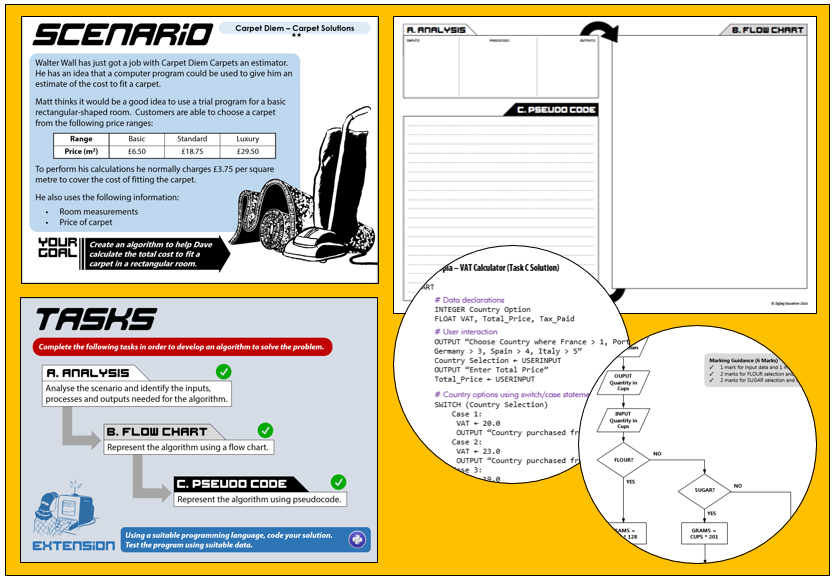
10 scenarios with tasks develop students’ understanding of abstraction, decomposition and algorithmic thinking. Perfect for use at KS4 level, including the new GCSE (9-1) Computer Science specifications!

Other resources I have used have been very focused on one or the other of these two areas, but this resource ensures that practical programming has a solid base in algorithm design.

R Walker (customer)
Scenarios feature a range of ‘real’ problems that students can relate to – greenhouse, paper-rock-scissors, password checker, and more!

For each scenario, students progress through the following tasks:

  • Task A – analyse the problem and identify inputs, processes and outputs
  • Tasks B and C – create visual representations of the problem using flow diagrams and pseudocode
  • Extension – produce a coded solution using a suitable language

Facilitating lessons are visually engaging PowerPoints which include the scenarios, tasks and solutions (including Python3 code for the extension) all in one place!

Use as a standalone resource for problem solving/skills development, or as part of a PoS when teaching relevant topics as part of a curriculum. Each scenario has difficulty grading and skills cross-referencing to aid your planning.
Share with others:

What do teachers say about this resource? (5828)

Fantastic - what a time saver. It would have taken me months to create the problems/tasks in this resource. I have used them with Y9 and Y10. The quality of the resource is excellent. I spent hours searching the web for a resources like this. It takes you through the whole computational thinking cycle from problem, flowcharts, Pseudocode and students can then even create the python code as an extra challenge... Saves a huge amount of time. Perfect to get KS3 and KS4 students thinking about computational thinking. It can also be used for GCSE as an introduction to algorithms, flowcharts and Pseudocode.

M Duke, customer

Provides a varied set of tasks that help to test pupils ability to apply programs to real world situations. The structure of the exercises encourages students to design the algorithms to various challenges first, and then try and implement their algorithms with whichever programming language they know.

The tasks set help to build students ability to create both written and practical solutions to a wide variety of different programming style challenges.

The exercises have been a great help for setting homework that can then be followed up with practical programming tasks in lesson.

They help bridge the gap between the theoretical and practical elements of programming. Other resources I have used have been very focused on one or the other of these two areas, but this ensures that practical programming has a solid base in algorithm design.

My students have found the resources useful as they develop their Computational Thinking skills, and especially like the balance of having tasks that require both theoretical and practical solutions.

R Walker (customer)

Nice activities... Allows students to stretch their minds and develop key skills for the course. A good match across multiple specs... Can be used for project based learning lessons, collaborative lesson activities and as cover work... I haven't come across a resource like it... Stuck for an idea for a lesson? Dip into this resource!

A Dolinski (customer)

Keywords

  • Programming support
  • computational thinking
  • Python

Fantastic

M Duke, customer

The exercises have been a great help for setting homework that can be followed up with practical programming tasks in lesson. They help bridge the gap between the theoretical and practical elements of programming.

R Walker (customer)

The quality of the resource is excellent... I spent hours searching the web for a resource like this.

M Duke, customer

I haven't come across a resource like it... Stuck for an idea for a lesson? Dip into this resource!

A Dolinski (customer)

What a time saver - it would have taken me months to create the problems/tasks in this resource.

M Duke, customer

Nice activities that allow students to stretch their minds and develop key skills... Can be used for project based learning lessons, collaborative lesson activities and as cover work.

A Dolinski (customer)

The tasks set help to build students ability to create both written and practical solutions to a wide variety of different programming style challenges... tests pupils ability to apply programs to real world situations.

R Walker (customer)

It takes you through the whole computational thinking cycle from problem, flowcharts, pseudocode and students can then even create the python code as an extra challenge... Perfect to get KS3 and KS4 students thinking about computational thinking.

M Duke, customer

© ZigZag Education®, Unit 3, Greenway Business Centre, Doncaster Road, Bristol BS10 5PY | Privacy Policy | Cookie Policy | Accessibility Policy 🤖 | Follow Us Join Us