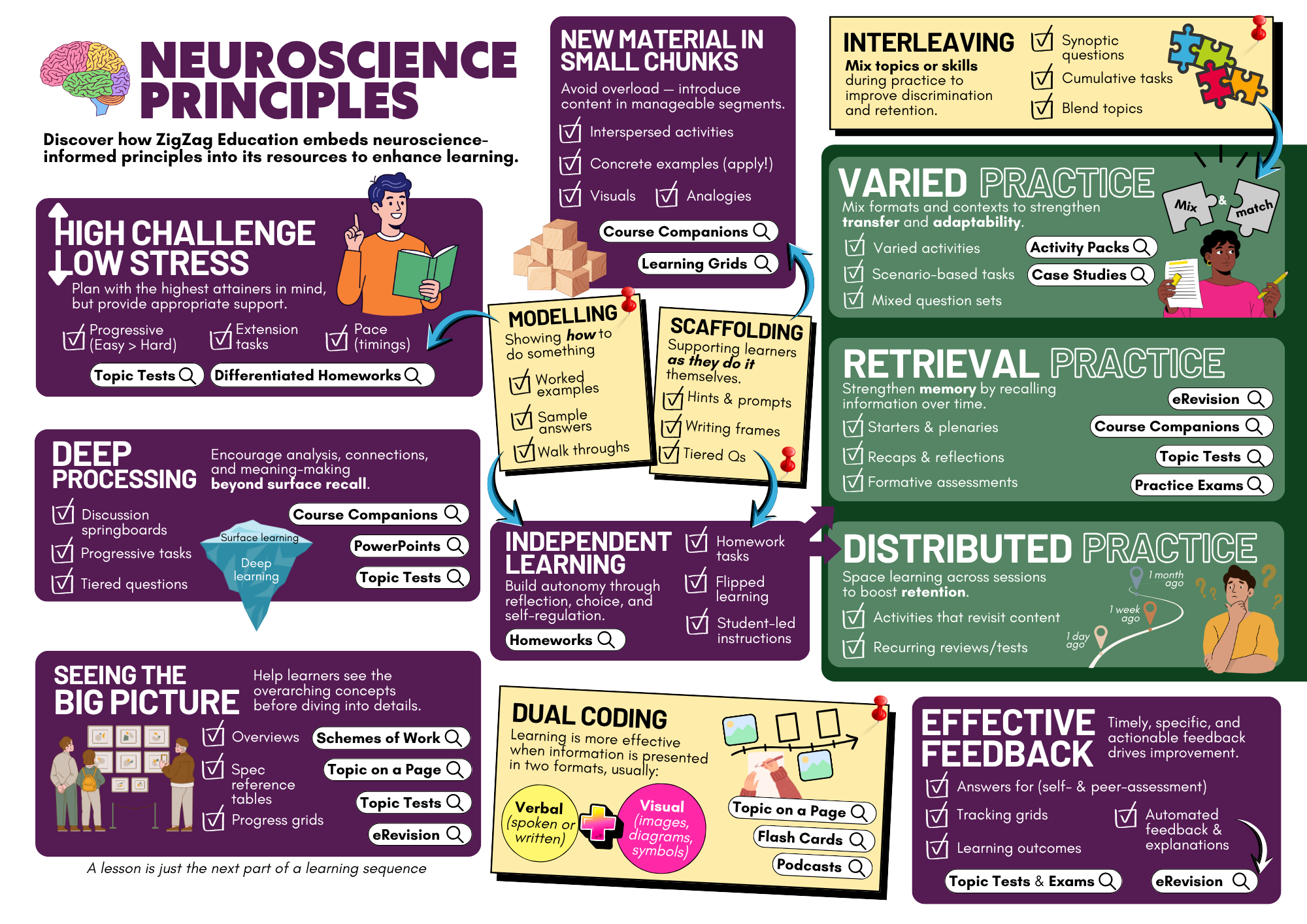
Applying Neuroscience: The science behind ZigZag Education’s teaching resources
Discover how ZigZag Education embeds neuroscience-informed principles into its resources to enhance learning. Click the poster to expand.
|
|
|
Check out ZigZag Education's core ranges...
| Range | Description |
|---|---|
| Course Companions | Comprehensive and engaging guides packed with in-depth content, fully aligned to the latest specification and assessment criteria. New material can be introduced in small, manageable chunks, supported by interspersed activities, examples, and worked models to aid understanding and encourage independent learning. Integrated applied and research tasks promote deeper thinking and challenge students to extend their learning. End-of-chapter questions provide opportunities for retrieval practice, while discussion springboards support deep processing. The structure also supports scaffolding, gradually building confidence and autonomy – ideal for in-class or independant learning. |
| Topic Tests | A precise and comprehensive diagnostic tool revealing students' strengths and weaknesses for each unit! Thoughtfully structured, each test gradually increasing in difficulty – from simple recall questions to multi-part tasks and inferential-style challenges – applying cognitive science principles to support deep learning:
|
| Topic on a Page | Visually engaging A3 revision posters with concise, easy-to-learn summaries of every specification topic. Designed to help students see the bigger picture, each page applies dual coding by combining written explanations with diagrams, flowcharts, and annotated visuals. This approach helps learners organise and connect ideas more effectively, supports memory through multiple representation formats, and reduces cognitive overload by chunking information into meaningful, accessible sections. |
| eRevision | Fast, effective, and engaging online learning designed to support students through interactive challenges covering every topic. Exam-style questions with model answers help reinforce understanding, while differentiated content supports learners across target grades. The progress tracking map helps students see the bigger picture, promoting metacognition (thinking about thinking) and goal-setting. Integrated computer marking provides timely, specific, and actionable feedback, driving improvement and encouraging independent learning. Hints and prompts offer scaffolding, while the structure supports retrieval practice, distributed practice, and interleaving – making revision more effective and personalised. |