

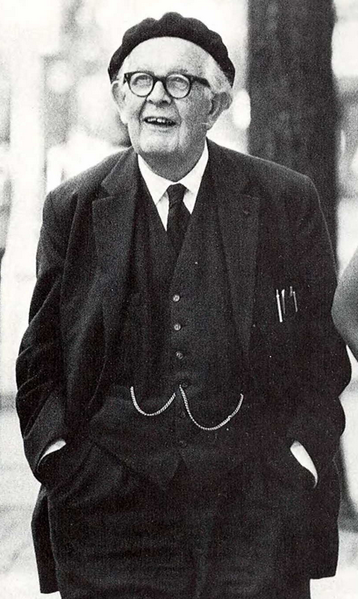
Piaget, Jean
Jean Piaget was born on 9th August in 1896 in Neuchatel, Switzerland. His father, Arthur Piaget, worked as a professor at the University of Neuchatel where he was a professor of romance languages and literature. Piaget spent the majority of his life living and working in Geneva.
Piaget first began his career in the field of natural sciences and zoology, which was his area of study when he enrolled at the University of Neuchatel in 1915. Here, he gained his Ph.D. in zoology but also developed his interests in epistemology (the theory of knowledge) and child development. Piaget’s interest in philosophy lead him to publish two philosophical papers during his time at university, which many now regard as pivotal to the direction of his future research.
In 1918, Piaget spent a period of time studying in Zurich under the supervision of Eugen Bleuler and Carl Jung as part of his post-doctoral training, which is where he was first introduced to methods of psychoanalysis. Combined with his interest in epistemology, this laboratory experience directed the course of his research and future work towards child psychology and the development of knowledge. Following this, Piaget left Switzerland and moved to France to pursue work at the Alfred Binet Institute, where he conducted his first experimental studies of intelligence and how the mind develops.
In 1923 Jean Piaget married Valentine Chatenay, with whom he went on to have three children with. As his children grew up, Piaget studied their intellectual and language development in order to develop his theory of cognitive development. These observations of his own children became crucial in the formation of his famous Four Stages of Cognitive Development where he suggests that children acquire knowledge progressively and in stages by taking an active role in the learning processes. In his theory of development and knowledge acquisition Piaget coined the term “schema” to describe the mental frameworks children use to understand the world and their environment, and that these schema shape how human’s interpret new information. Piaget was one of the first psychologists to put forward the theory that children’s minds are not simply smaller versions of adult minds, but different entirely and therefore no less intelligent just because they think differently. Notably, Albert Einstein referred to Piaget’s work as “so simple that only a genius could have thought of it.”
Piaget held various positions and several chairs in academic institutions, for example directing the International Bureau of Education in Geneva from 1929 until 1967, and founding the International Center for Genetic Epistemology in 1955. Piaget primarily spent his career at the Rousseau Institute in Geneva where he worked as the director of studies. Despite not being his intention at the time, Piaget’s work has today become an influential power in education-reform movements, such as highlighting the importance of educating a child at their developmental level, utilising constructivist and interactive approaches to a child’s knowledge acquisition.
Piaget dedicated his life to his work, and eventually died on 16th September in 1980 with works still in progress.
© ZigZag Education 2026: content may be used by students for educational use if this page is referenced.
Show / hide details
| 1896 |
Birth
|
|
| 1907 |
Published his first short work
|
|
| 1911 |
Piaget starts to become recognised for his early work
|
|
| 1918 |
Obtained his Ph.D. in zoology
|
|
| 1919 |
Piaget studied in Zurich
|
|
| 1919-1921 |
Piaget studied in Paris
|
|
| 1921 |
Appointed Director of the Institut J.J. Rousseau
|
|
| 1923 |
Married Valentine Chatenay
|
|
| 1923 |
Published The Language and Thought of the Child
|
|
| 1925-1929 |
Became a professor at the University of Neuchatel
|
|
| 1929 |
Joined the University of Geneva as professor
|
|
| 1932 |
Published The Moral Judgement of the Child |
|
| 1936 |
Published The Origins of Intelligence and Children
|
|
| 1945 |
Published The Construction of Reality in the Child |
|
| 1947 |
Published The Psychology of Intelligence |
|
| 1955 |
Founded the International Centre of Genetic Epistemology at Geneva |
|
| 1980 |
Death
|
About the Contributor
Sophie Allan
30–47 ready-to-use activities fully aligned to the specification and assessment criteria, covering all of Unit 1: Children’s Development and Unit 3: Play and Learning.
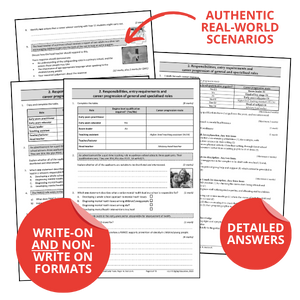
Suitable for First Teach 2025 (Generation 1 students)
A precise and comprehensive diagnostic tool revealing students strengths and weaknesses for each section of the exams!
Thoughtfully structured, with each test gradually increasing in difficulty. From simple recall, targeting key points, to multi-part questions requiring greater initiative to finally longer inferential-style questions.
Questions include many case study scenarios to link theory and practice in the education and early years sectors.
Varied question styles through match-ups, tables, graphics or images, maximise engagement and covers the formats expected in the exams.
Dual formats: write-on and re-useable non-write on. Efficient Assessment: Tests take just 30-60 minutes each!
Covering each section of the exam papers of the T Level Technical Qualification in Education and Early Years Specification.
Use in-class, for revision or as homeworks!
Comprehensive answers with mark allocations for effective peer- and self-assessment.
A precise and comprehensive diagnostic tool revealing students strengths and weaknesses for each section of the exams!
Thoughtfully structured, with each test gradually increasing in difficulty. From simple recall, targeting key points, to multi-part questions requiring greater initiative to finally longer inferential-style questions.
Questions include many case study scenarios to link theory and practice in the education and early years sectors.
Varied question styles through match-ups, tables, graphics or images, maximise engagement and covers the formats expected in the exams.
Dual formats: write-on and re-useable non-write on. Efficient Assessment: Tests take just 30-60 minutes each!
Covering each section of the exam papers of the T Level Technical Qualification in Education and Early Years Specification.
Use in-class, for revision or as homeworks!
Comprehensive answers with mark allocations for effective peer- and self-assessment.
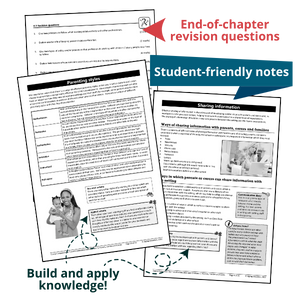
Suitable for First Teach 2025 (Generation 1 students)
Keep students on the right track with these clear and comprehensive course notes for the core component. Relevant to all occupational specialisms and written in student-friendly language.
Accessible notes at an appropriate level and in sufficient depth.
Creative case studies covering a range of environments and individuals from both teaching and early years settings – build connections between theory and practical application.
Thought-provoking images and diagrams.
End-of-chapter revision questions.
Keep students on the right track with these clear and comprehensive course notes for the core component. Relevant to all occupational specialisms and written in student-friendly language.
Accessible notes at an appropriate level and in sufficient depth.
Creative case studies covering a range of environments and individuals from both teaching and early years settings – build connections between theory and practical application.
Thought-provoking images and diagrams.
End-of-chapter revision questions.

A precise and comprehensive diagnostic tool!
Reveal students strengths and weaknesses with these progressive topic-by-topic question banks written for every topic (from Paper 1 and Paper 2) for the AQA GCSE Psychology specification.
4–8 thoughtfully structured tests, each gradually increasing in difficulty. From simple recall, targeting key points, to multi-part questions requiring greater initiative to finally longer inferential-style questions. Great for consolidating learning at the end of a topic in class, for revision or as homeworks.
Dual formats: write-on and re-useable non-write on.
Efficient Assessment: Tests take just 25-40 minutes each!
Varied question styles through Case Studies, tables, images, or graphs, maximise engagement and formats expected in the exams.
Questions include many real-life applications to link theory and practice.
Data sets offer a practical means to assess students' data interpretation skills.
Comprehensive answers with mark allocations for effective peer- and self-assessment.
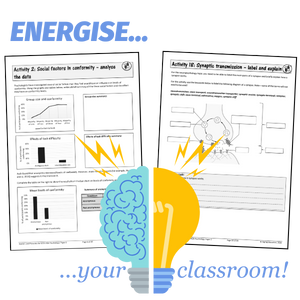
Inject energy into your GCSE Psychology lessons and keep learning on track until the final bell with this dynamic collection of starter and plenary activities.
31-34 ready-to-use, in-class activities with teacher's notes and write-on student worksheets to boost engagement and energise your classroom.
All answers provided for effective AfL and peer-assessment.

Up to 20 stand-alone homework sheets with up to 40 activities covering the A Level AQA Psychology topics. Ready-to-use and easy-to-set, write-on homework sheets, with answers included.
These homeworks provide a variety of questions, tasks & activities to help understanding of the topic, develop key exam skills & cover all assessment objectives.
Varied and interesting activities to engage students – includes case study evaluation, match-ups, gap-fills and more!
Exam-style activities for AS and A Level – co-teachable and brilliant for revision.
Mastermind tasks challenge the most able – make differentiation easy.
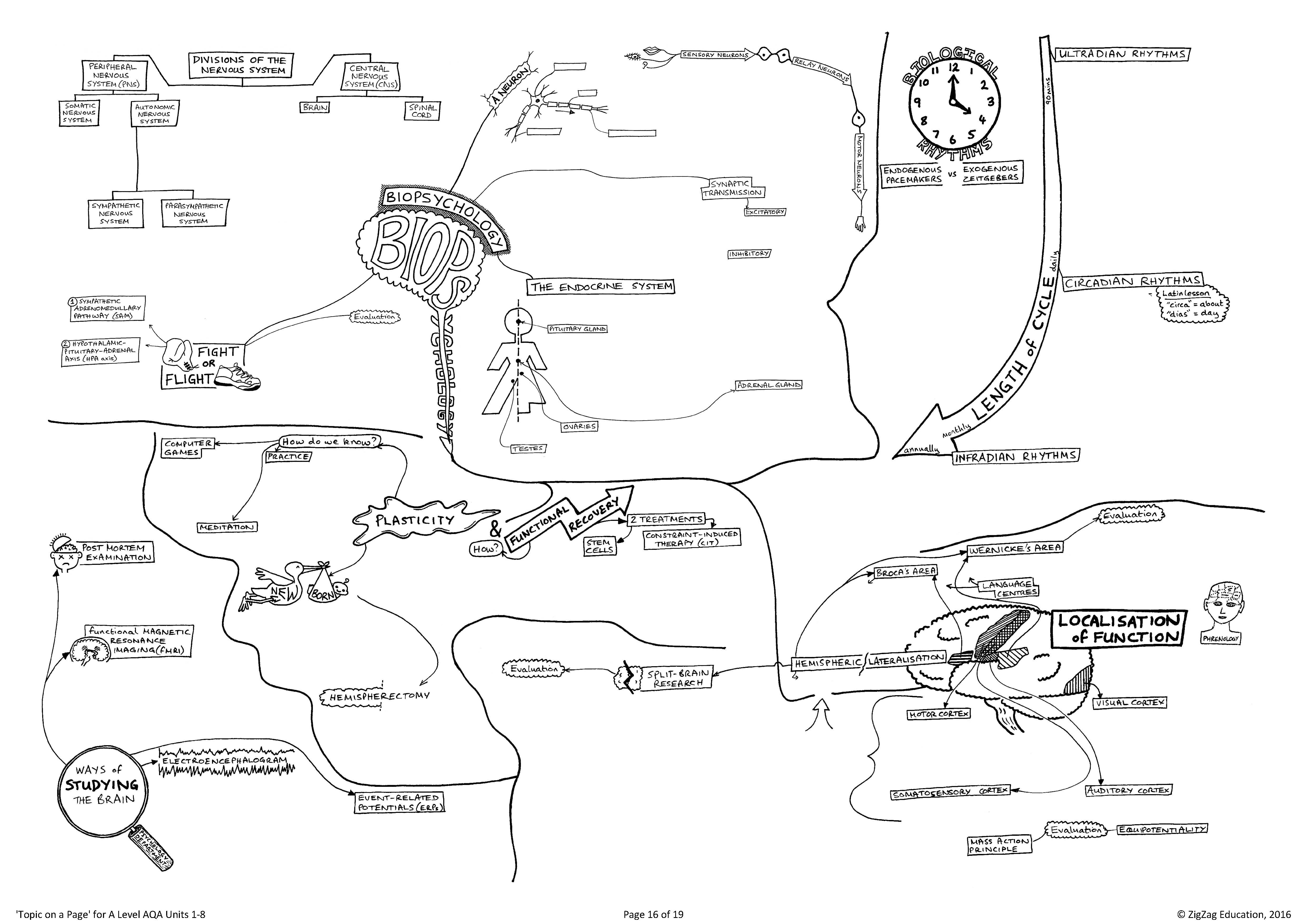
Visually engaging A3 posters with concise, easy-to-learn summaries of all eight compulsory topics of the AQA A Level specification. Help students see the bigger picture on an entire topic.
Included for each of the topics:
A3 Summary Poster giving at-a-glance overview
Partially complete A3 Activity Poster to test knowledge and challenge high-ability learners

Consolidate and extend learning in class with these short and stimulating activities for the AQA A Level Psychology specification.
24–38 write-on, topic-specific activities from memory-recall experiments for Memory to brain and neuron annotation tasks for Biopsychology. Carefully designed with a strong focus on classroom learning and exam preparation.

Keep students on the right track in AQA A-Level Psychology with these clear and comprehensive course notes. Written in a student-friendly language and organised in specification order, including:
Clear learning outcomes at the start of each chapter for focused work
Accessible notes – at an appropriate level and in sufficient depth – ensuring clear explanations of core concepts
Integrated tasks stimulate students interest!
Thought-provoking visual images and diagrams to stimulate all learners
PLUS! End-of-topic consolidation questions test and assess students’ knowledge!
Versatile resource: use either as teaching notes, as an alternative to the textbook or as topic handouts, or upgrade to editable Word version to adapt for your pupils’ specific needs.
Acknowledgements
Public Domain image from https://commons.wikimedia.org/wiki/File:Jean_Piaget_in_Ann_Arbor.png
