

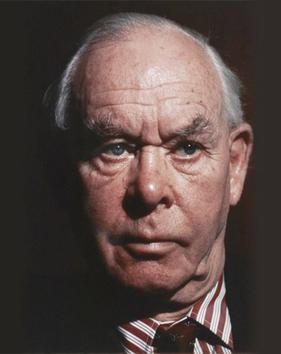
Bowlby, John
John Bowlby was born on 26th February in 1907. He was born into an upper-middle-class family that consisted of parents Anthony Bowlby, a British army officer and surgeon for the King’s household, and Mary Bridget Mostyn. Bowlby’s parents believed that spending too much time with their children would make them spoiled, and so limited the amount of time they interacted with their children in the day. Bowlby would usual see his mother for one hour after tea per day, with the family nursemaid looking after Bowlby and his five siblings the rest of the time. Bowlby was sent to boarding school at the age of seven where he reported having negative experiences. These childhood are experiences are likely what drew Bowlby to studying attachment to primary caregivers, and ultimately creating his attachment theory.
In 1921, Bowlby trained to be a naval officer at the Britannia Royal Naval College before enrolling at Trinity College, Cambridge to study medicine. A couple of years into his degree, Bowlby’s focus shifted towards psychology and he graduated university in 1928. Following his graduation, Bowlby spent the next year working in schools designed for children with behavioural difficulties, inspiring him to pursue a career in child psychiatry.
Bowlby then studied medicine at the University College Hospital and joined the British Psychoanalytic Institute. After gaining his medical qualification in 1933 Bowlby began training in adult psychiatry in London at the Maudsley Hospital, before later working as a psychiatrist for children with behavioural difficulties at the London Child Guidance Clinic. Here, Bowlby gained inspiration for his attachment theory due to the school’s belief about why children have behavioural issues – they believed that it was due to previous negative experiences within the child’s family, which is something that particularly resonated with Bowlby and reminded him of his own absent parents. Bowlby used this experience to conduct his own research at the Tavistock Institute in London into children’s attachments to their primary caregivers, specifically focusing on the effects of separation between the two. This is where he developed his famous and influential attachment theory.
Bowlby was a pioneer in the area of attachment, with his main theory suggesting that children who fail to develop a close attachment to a primary caregiver within a critical period will experience behavioural issues later in life. Bowlby’s inspiration for his research in part came from his own childhood experiences, but also the evacuation of children during the Second World War – many children were separated from their primary caregivers for an extended period of time, and the extent of effects of this were not yet known. This theory has become a cornerstone of early childhood education and care, and emphasises the importance of children growing up in a secure, safe, and stable environment. His research has led to many impactful policies and practices being developed, such as trauma-informed approaches to child education, family-based care being prioritised in social work, and early-intervention programmes for children who may be at risk. Bowlby also highlighted the importance of early childhood attachment figures on later relationships, and argued that a child’s first attachment is what they will then base all future relationships on, as well as having effects on how the child perceives themselves and others.
In 1950, Bowlby became a mental health consultant for the World Health Organisation where he wrote a report on the mental health of homeless children in Europe. This became one of Bowlby’s most influential pieces of work, and his research into attachment inspired many other well-known psychologists, for example Mary Ainsworth who developed the Strange Situation and identified different attachment styles.
Bowlby continued to develop his work into attachment throughout the rest of his life, working alongside many other influential psychologists. Bowlby died at his summer home on the Isle of Skye on 2nd September, 1990.
© ZigZag Education 2026: content may be used by students for educational use if this page is referenced.
Show / hide details
| 1907 |
Birth
|
|
| 1914 |
Sent to boarding school
|
|
| 1921 |
Enrolled at the Britannia Royal Naval College in Dartmouth
|
|
| 1925 |
Enrolled at Trinity College, Cambridge
|
|
| 1927 |
Begins focusing on psychology
|
|
| 1928 |
Bowlby graduated university
|
|
| 1928-1929 |
Volunteered at school for children with behavioural difficulties
|
|
| 1929 |
Enrolled at University College Hospital
|
|
| 1933 |
Obtained his medical qualification |
|
| 1937-1940 |
Worked as a psychiatrist at the London Child Guidance Clinic
|
|
| 1938 |
Married Ursula Longstaff |
|
| 1944 |
Published his 44 Thieves study |
|
| 1946 |
Started work at Tavistock
|
|
| 1950 |
Bowlby became a mental health consultant for the World Health Organisation |
|
| 1951 |
Published his WHO report
|
|
| 1953 |
Published Child Care and the Growth of Love |
|
| 1969 |
First publication in the Attachment and Loss trilogy
|
|
| 1973 |
Publication of Separation: Anxiety and Anger
|
|
| 1980 |
Publication of Loss: Sadness and Depression
|
|
| 1990 |
Death
|
About the Contributor
Sophie Allan
30–47 ready-to-use activities fully aligned to the specification and assessment criteria, covering all of Unit 1: Children’s Development and Unit 3: Play and Learning.
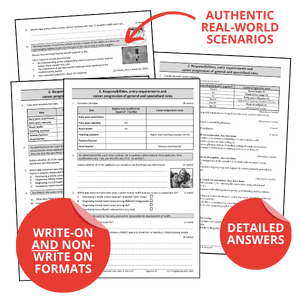
Suitable for First Teach 2025 (Generation 1 students)
A precise and comprehensive diagnostic tool revealing students strengths and weaknesses for each section of the exams!
Thoughtfully structured, with each test gradually increasing in difficulty. From simple recall, targeting key points, to multi-part questions requiring greater initiative to finally longer inferential-style questions.
Questions include many case study scenarios to link theory and practice in the education and early years sectors.
Varied question styles through match-ups, tables, graphics or images, maximise engagement and covers the formats expected in the exams.
Dual formats: write-on and re-useable non-write on.
Efficient Assessment: Tests take just 30-60 minutes each!
Covering each section of the exam papers of the T Level Technical Qualification in Education and Early Years Specification.
Use in-class, for revision or as homeworks!
Comprehensive answers with mark allocations for effective peer- and self-assessment.
A precise and comprehensive diagnostic tool revealing students strengths and weaknesses for each section of the exams!
Thoughtfully structured, with each test gradually increasing in difficulty. From simple recall, targeting key points, to multi-part questions requiring greater initiative to finally longer inferential-style questions.
Questions include many case study scenarios to link theory and practice in the education and early years sectors.
Varied question styles through match-ups, tables, graphics or images, maximise engagement and covers the formats expected in the exams.
Dual formats: write-on and re-useable non-write on.
Efficient Assessment: Tests take just 30-60 minutes each!
Covering each section of the exam papers of the T Level Technical Qualification in Education and Early Years Specification.
Use in-class, for revision or as homeworks!
Comprehensive answers with mark allocations for effective peer- and self-assessment.

A precise and comprehensive diagnostic tool!
Reveal students strengths and weaknesses for every compulsory topic (1-8) of the AQA A level Psychology specification.
4–8 thoughtfully structured tests, each gradually increasing in difficulty. From simple recall, targeting key points, to multi-part questions requiring greater initiative to finally longer inferential-style questions.
Varied question styles through Case Studies, tables, images, or graphs, maximise engagement and formats expected in the exams.
Questions include many real-life applications to link theory and practice.
Data sets offer a practical means to assess students' data interpretation skills.
Dual formats: write-on and re-useable non-write on.
Efficient Assessment: Tests take just 45-60 minutes each!
Use in-class, for revision or as homeworks!
Comprehensive answers with mark allocations for effective peer- and self-assessment.
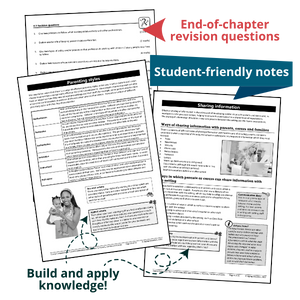
Suitable for First Teach 2025 (Generation 1 students)
Keep students on the right track with these clear and comprehensive course notes for the core component. Relevant to all occupational specialisms and written in student-friendly language.
Accessible notes at an appropriate level and in sufficient depth.
Creative case studies covering a range of environments and individuals from both teaching and early years settings – build connections between theory and practical application.
Thought-provoking images and diagrams.
End-of-chapter revision questions.
Keep students on the right track with these clear and comprehensive course notes for the core component. Relevant to all occupational specialisms and written in student-friendly language.
Accessible notes at an appropriate level and in sufficient depth.
Creative case studies covering a range of environments and individuals from both teaching and early years settings – build connections between theory and practical application.
Thought-provoking images and diagrams.
End-of-chapter revision questions.

Provide a structured pathway to teach with this set of nine organised, flexible lesson plans covering the 2015 AQA specification. Easily adaptable to your own teaching requirements and textbook choices.
Each lesson is supported by handouts, worksheets, homework ideas & in-class activities:
Thought provoking questions help students grasp key concepts and fuel class discussion
Reinforce knowledge by replicating classic experiments and challenging students to explain the results
Imaginative activities ensure all Assessment Objectives are covered.

Consolidate and extend learning in class with these short and stimulating activities for the AQA A Level Psychology specification.
24–38 write-on, topic-specific activities from memory-recall experiments for Memory to brain and neuron annotation tasks for Biopsychology. Carefully designed with a strong focus on classroom learning and exam preparation.
Perfect mixture of activities motivates and enthuses all learning styles.
Excellently matched to Assessment Objectives.
Ideal blend of individual, paired, small-group and whole-class activities develops independent and cooperative learning methods

Up to 20 stand-alone homework sheets with up to 40 activities covering the A Level AQA Psychology topics. Ready-to-use and easy-to-set, write-on homework sheets, with answers included.
These homeworks provide a variety of questions, tasks & activities to help understanding of the topic, develop key exam skills & cover all assessment objectives.
Varied and interesting activities to engage students – includes case study evaluation, match-ups, gap-fills and more!
Exam-style activities for AS and A Level – co-teachable and brilliant for revision.
Mastermind tasks challenge the most able – make differentiation easy.

Keep students on the right track in AQA A-Level Psychology with these clear and comprehensive course notes. Written in a student-friendly language and organised in specification order, including:
Versatile resource: use either as teaching notes, as an alternative to the textbook or as topic handouts, or upgrade to editable Word version to adapt for your pupils’ specific needs.
Clear learning outcomes at the start of each chapter for focused work
Accessible notes – at an appropriate level and in sufficient depth – ensuring clear explanations of core concepts
Integrated tasks stimulate students interest!
Thought-provoking visual images and diagrams to stimulate all learners
PLUS! End-of-topic consolidation questions test and assess students’ knowledge!
Acknowledgements
Creative Commons Attribution-Share Alike 4.0 International
https://commons.wikimedia.org/wiki/File:John_Bowlby_Image.jpg
