

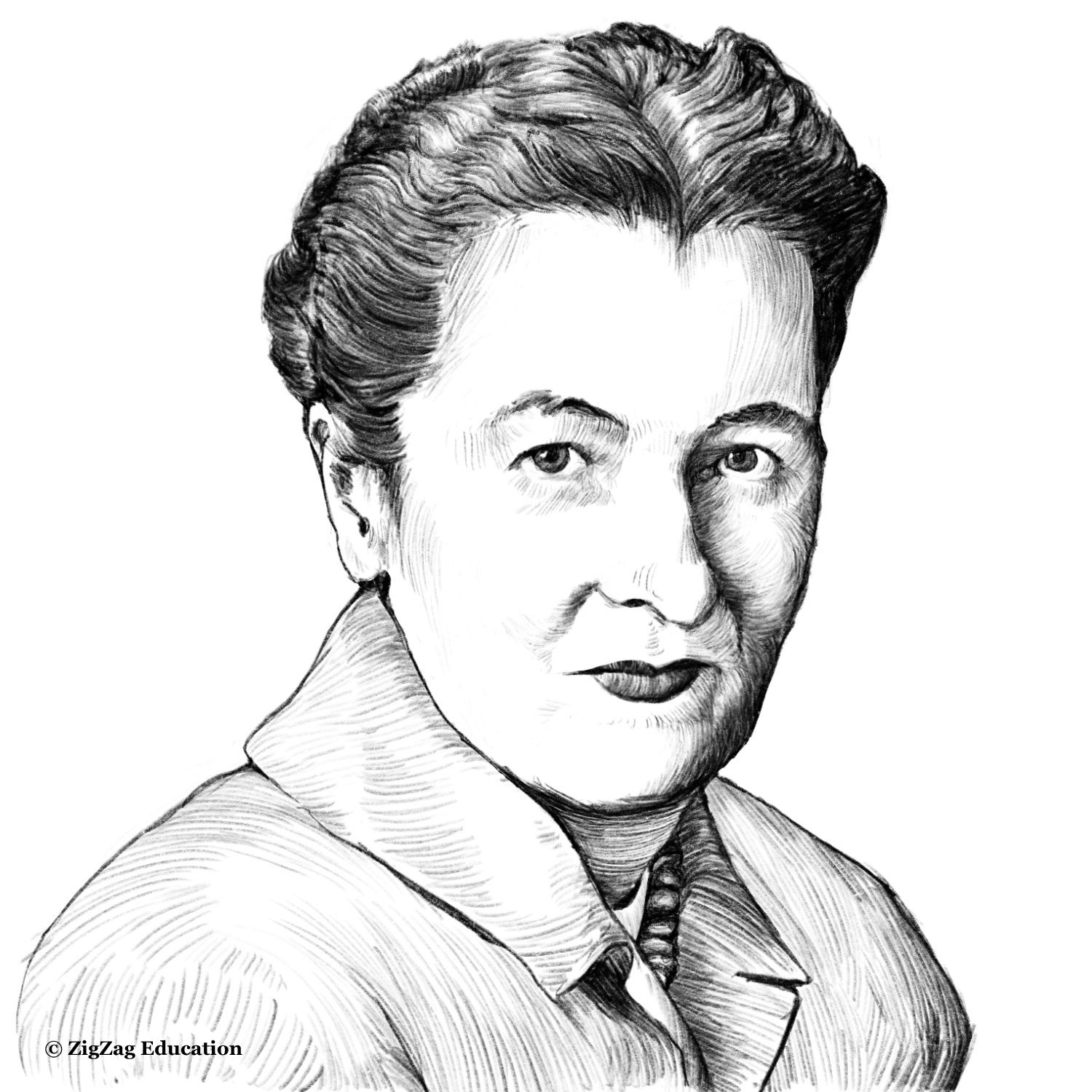
Ainsworth, Mary
Mary Ainsworth, née Mary Dinsmore Salter, was born on 1st December, 1913 in Ohio, United States. She was born into a family that highly valued education, with the family relocating to Toronto, Canada when she was five years old due to her father’s work. When she was 15 years old, Ainsworth read Character and the Conduct of Life by William McDougall which is what first piqued her interest in psychology and inspired her to study and pursue a career in the field.
Ainsworth enrolled at the University of Toronto to study psychology in 1931 and went on to obtain her master’s degree and Ph.D. there. After completing her doctorate, Ainsworth spent the next few years teaching at the university before joining the Canadian Women’s Army Corp in 1942 to help aid the war effort and put her skills to use. She worked as an Army Examiner where she then became Advisor to the Director of Personnel Selection due to her previous role in assessing and interviewing recruits. In 1950 she married Leonard Ainsworth, who was also a psychologist, and the pair moved to London.
It was in London that Ainsworth joined the Tavistock Institute and first became acquainted with John Bowlby – a pioneering developmental psychologist. Ainsworth became interested in the area of attachment after working with Bowlby, which is ultimately what launched her influential career in attachment theory. In 1953 the couple relocated as Ainsworth’s husband was offered a post-doctoral position in Uganda. Here, Ainsworth took the opportunity to study attachment between mothers and their infants, providing valuable cross-cultural insights into attachment. Following her time in Uganda, Ainsworth moved to Baltimore, Maryland and found work at a psychiatric hospital whilst also lecturing at John Hopkins University, becoming an associate professor of developmental psychology in 1958.
Mary and Leonard Ainsworth divorced in 1960, and in 1963 Ainsworth launched the Baltimore Project – a project that consisted of monthly visits to 26 different families with infants until the infants turned 12 months old. At 12 months, the infants and their caregiver took part in the Strange Situation experiment. Mary Ainsworth is arguably most well-known for her development of the Strange Situation – a laboratory procedure designed to measure the quality of attachments between infants and their caregivers. Ainsworth’s Baltimore Project identified three main attachment styles (secure, insecure-avoidant, and insecure-resistant) and the findings of this study have become extremely influential in shaping our understanding of attachment. Ainsworth published her findings and first introduced the Strange Situation in her 1969 review A theoretical review of the mother-infant relationship.
In 1975 Ainsworth joined the University of Virginia and in 1976 became Commonwealth Professor of Psychology, and in 1978 published one of her most notable works, Patterns of Attachment, which develops and expands on her theories of attachment styles. Ainsworth retired as Professor Emeritus in 1984 and received many awards throughout her career, including the Gold Medal Award for Life Achievement in the Science of Psychology from the American Psychological Foundation in 1998. Mary Ainsworth eventually died on 21st March in 1999 in Virginia, US.
© ZigZag Education 2026: content may be used by students for educational use if this page is referenced.
Show / hide details
| 1913 |
Birth
|
|
| 1918 |
Ainsworth's family moves to Toronto
|
|
| 1928 |
Read Character and the Conduct of Life
|
|
| 1931 |
Enrolled at the University of Toronto
|
|
| 1935 |
Graduated university with her Bachelors degree |
|
| 1936 |
Gained her Masters degree
|
|
| 1939 |
Obtained her Ph.D.
|
|
| 1939-1942 |
Taught at the University of Toronto |
|
| 1942 |
Joined the war effort
|
|
| 1950 |
Married Leonard Ainsworth
|
|
| 1950 |
Moved to London
|
|
| 1950 |
Joined Bowlby's research team
|
|
| 1953 |
Temporarily relocated to Uganda
|
|
| 1953 |
The Ainsworths moved to Baltimore
|
|
| 1958 |
Became Associate Professor of Developmental Psychology |
|
| 1960 |
Divorce
|
|
| 1963 |
Launched the Baltimore Project |
|
| 1969 |
Published A theoretical review of the infant-mother relationship
|
|
| 1975 |
Joined the University of Virginia |
|
| 1976 |
Became Commonwealth Professor of Psychology |
|
| 1978 |
Published Patterns of Attachment
|
|
| 1984 |
Retired as Professor Emeritus |
|
| 1998 |
Awarded the Gold Medal Award for Life Achievement in the Science of Psychology
|
|
| 1998 |
Death
|
About the Contributor
Sophie Allan

30–47 ready-to-use activities fully aligned to the specification and assessment criteria, covering all of Unit 1: Children’s Development and Unit 3: Play and Learning.
Suitable for First Teach 2025 (Generation 1 students)
A precise and comprehensive diagnostic tool revealing students strengths and weaknesses for each section of the exams!
Thoughtfully structured, with each test gradually increasing in difficulty. From simple recall, targeting key points, to multi-part questions requiring greater initiative to finally longer inferential-style questions.
Questions include many case study scenarios to link theory and practice in the education and early years sectors.
Varied question styles through match-ups, tables, graphics or images, maximise engagement and covers the formats expected in the exams.
Dual formats: write-on and re-useable non-write on. Efficient Assessment: Tests take just 30-60 minutes each!
Covering each section of the exam papers of the T Level Technical Qualification in Education and Early Years Specification.
Use in-class, for revision or as homeworks!
Comprehensive answers with mark allocations for effective peer- and self-assessment.
A precise and comprehensive diagnostic tool revealing students strengths and weaknesses for each section of the exams!
Thoughtfully structured, with each test gradually increasing in difficulty. From simple recall, targeting key points, to multi-part questions requiring greater initiative to finally longer inferential-style questions.
Questions include many case study scenarios to link theory and practice in the education and early years sectors.
Varied question styles through match-ups, tables, graphics or images, maximise engagement and covers the formats expected in the exams.
Dual formats: write-on and re-useable non-write on. Efficient Assessment: Tests take just 30-60 minutes each!
Covering each section of the exam papers of the T Level Technical Qualification in Education and Early Years Specification.
Use in-class, for revision or as homeworks!
Comprehensive answers with mark allocations for effective peer- and self-assessment.

A precise and comprehensive diagnostic tool!
Reveal students strengths and weaknesses for every compulsory topic (1-8) of the AQA A level Psychology specification.
4–8 thoughtfully structured tests, each gradually increasing in difficulty. From simple recall, targeting key points, to multi-part questions requiring greater initiative to finally longer inferential-style questions.
Varied question styles through Case Studies, tables, images, or graphs, maximise engagement and formats expected in the exams.
Questions include many real-life applications to link theory and practice.
Data sets offer a practical means to assess students' data interpretation skills.
Dual formats: write-on and re-useable non-write on.
Efficient Assessment: Tests take just 45-60 minutes each!
Use in-class, for revision or as homeworks!
Comprehensive answers with mark allocations for effective peer- and self-assessment.
Suitable for First Teach 2025 (Generation 1 students)
Keep students on the right track with these clear and comprehensive course notes for the core component. Relevant to all occupational specialisms and written in student-friendly language.
Accessible notes at an appropriate level and in sufficient depth.
Creative case studies covering a range of environments and individuals from both teaching and early years settings – build connections between theory and practical application.
Thought-provoking images and diagrams.
End-of-chapter revision questions.
Keep students on the right track with these clear and comprehensive course notes for the core component. Relevant to all occupational specialisms and written in student-friendly language.
Accessible notes at an appropriate level and in sufficient depth.
Creative case studies covering a range of environments and individuals from both teaching and early years settings – build connections between theory and practical application.
Thought-provoking images and diagrams.
End-of-chapter revision questions.

Provide a structured pathway to teach with this set of nine organised, flexible lesson plans covering the 2015 AQA specification. Easily adaptable to your own teaching requirements and textbook choices.
Each lesson is supported by handouts, worksheets, homework ideas & in-class activities:
Thought provoking questions help students grasp key concepts and fuel class discussion
Reinforce knowledge by replicating classic experiments and challenging students to explain the results
Imaginative activities ensure all Assessment Objectives are covered.

Consolidate and extend learning in class with these short and stimulating activities for the AQA A Level Psychology specification.
24–38 write-on, topic-specific activities from memory-recall experiments for Memory to brain and neuron annotation tasks for Biopsychology. Carefully designed with a strong focus on classroom learning and exam preparation.
Perfect mixture of activities motivates and enthuses all learning styles.
Excellently matched to Assessment Objectives.
Ideal blend of individual, paired, small-group and whole-class activities develops independent and cooperative learning methods.

Up to 20 stand-alone homework sheets with up to 40 activities covering the A Level AQA Psychology topics. Ready-to-use and easy-to-set, write-on homework sheets, with answers included.
These homeworks provide a variety of questions, tasks & activities to help understanding of the topic, develop key exam skills & cover all assessment objectives.
Varied and interesting activities to engage students – includes case study evaluation, match-ups, gap-fills and more!
Exam-style activities for AS and A Level – co-teachable and brilliant for revision.
Mastermind tasks challenge the most able – make differentiation easy.

Keep students on the right track in AQA A-Level Psychology with these clear and comprehensive course notes. Written in a student-friendly language and organised in specification order, including:
Versatile resource: use either as teaching notes, as an alternative to the textbook or as topic handouts, or upgrade to editable Word version to adapt for your pupils’ specific needs.
Clear learning outcomes at the start of each chapter for focused work
Accessible notes – at an appropriate level and in sufficient depth – ensuring clear explanations of core concepts
Integrated tasks stimulate students interest!
Thought-provoking visual images and diagrams to stimulate all learners.
PLUS! End-of-topic consolidation questions test and assess students’ knowledge!
Acknowledgements
CC: ZigZag Education